
Frequently Asked Questions (FAQ)
Technical specifications, optical design rules, and ordering answers for Vortex Photonics Spiral Phase Plates (Vortex Lenses), Phase Steps / Mode Converters, Circular Pi Plates (Axial Phase Plates), and Custom Optical Components.
| Product Line | Phase Profile | Output Beam | Standard Range | Primary Applications |
|---|---|---|---|---|
| 1. Spiral Phase Plates (SPPs) | Helical azimuthal ramp (64-level, ±5 nm) | 2D xy-doughnut optical vortex carrying OAM | 193 nm – 3.5 µm Charges ℓ = 1 – 32 |
2D/3D STED, MINFLUX, optical tweezers, laser machining, OAM telecom, quantum optics |
| 2. Phase Steps / Mode Converters | Linear π phase step(s) etched in fused silica | Higher-order Hermite-Gaussian modes (TEM01–TEM016) | 400, 532, 780, 800, 1030 nm 10 & 20 mm apertures |
Optical cavities & resonators, optical tweezers, atomic & molecular excitation |
| 3. Circular Pi Plates | Binary central circular π-shifted zone | 3D bottle beam (z-doughnut) with axial null | 405 – 1064 nm Zones d = 0.2, 1.0, 2.0, 3.0 mm |
3D STED axial depletion, MINFLUX, dark optical traps for cold atoms, depth-of-focus engineering |
1. Spiral Phase Plates (Vortex Lenses)
What is a Spiral Phase Plate (Vortex Lens), and how does it work?
A Spiral Phase Plate (SPP)—also called a vortex lens or vortex phase plate—is a diffractive optical element (DOE) with a helical, staircase-like surface profile that imparts an azimuthal phase ramp around the beam axis.
When a standard plane Gaussian laser beam passes through an SPP, it is converted into an optical vortex carrying orbital angular momentum (OAM), producing a “doughnut-shaped” intensity profile with a dark zero-intensity phase singularity at its center.

What topological charges and wavelengths do your Spiral Phase Plates support?
Our standard Spiral Phase Plate catalog covers:
- Topological charges (ℓ or m): Standard values from 1 to 32 (with off-the-shelf part numbers for ℓ = 1, 2, 3, 4, 5, 6, 7, 8, 10, and 16), plus higher topological charges on request.
- Spectral range: From the deep ultraviolet (193 nm) through the visible and near-infrared up to 3.5 µm, including stock lines at 193, 213, 266, 355, 405, 415, 450, 467, 488, 515, 520, 525, 532, 561, 593, 633, 650, 660, 775, 780, 790, 800, 1030, 1064, 1400, 1550, 1800, 2000, and 2090 nm.


Want to calculate the exact focused ring peak diameter, FWHM / 1/e² ring width, and astigmatism behavior for your wavelength and charge?
Calculate focal ring size in Optics Toolbox →Are your Spiral Phase Plates continuous or stepped?
We manufacture multi-level spiral phase plates with 64 step quantization and a typical step-height deviation of only ±5 nm from theory, with stepless spiral phase plates planned for the near future.
A higher number of discrete steps suppresses parasitic diffraction orders and yields a deeper, darker central intensity region in the doughnut beam—which is critical for applications such as STED, MINFLUX, optical vortex coronagraphs, and nano-lithography.
Compare continuous vs. 64-level efficiency (far & near field) →
What are Spiral Phase Plates used for?
Vortex lenses are deployed in both academic laboratories and industrial OEM systems across:
- Super-Resolution Microscopy: 2D/3D STED, MINFLUX, MINSTED, and RASTMIN nanoscopy.
- Optical Tweezers & Trapping: Trapping and rotating microscopic particles via orbital angular momentum transfer.
- Atomic & Molecular Excitation: Spatially localized excitation in doped solids and cold-atom setups.
- Astronomy & Lithography: Optical vortex coronagraphs and nano-lithography.
- Laser Material Processing: High-precision laser cutting, drilling, and micromachining.
- Telecommunications & Quantum Optics: Orbital angular momentum (OAM) optical data transfer and high-dimensional quantum state generation.
Read our published papers to see these applications in action.
How are optical vortices used in optical tweezers?
In optical trapping and tweezing, the doughnut-shaped intensity profile generated by a spiral phase plate traps microscopic particles within the ring or low-intensity core. Furthermore, the orbital angular momentum (OAM) carried by the helical wavefront can be transferred directly to the trapped particles, causing them to physically orbit or rotate.
Why are vortex lenses important for STED microscopy?
In Stimulated Emission Depletion (STED) microscopy, a spiral phase plate shapes the depletion laser into a doughnut profile with a zero-intensity center. This beam switches off fluorescence everywhere around the exact focal center while leaving fluorophores at the dark core active, allowing researchers to achieve imaging resolutions far beyond the standard diffraction limit. For 3D STED, it is paired with a Circular Pi Plate.
2. Phase Steps & Hermite-Gaussian Mode Converters
What are Hermite-Gaussian Mode Converters (Phase Steps), and what modes do they generate?
Phase Steps / Mode Converters feature one or more linear physical steps etched into fused silica to introduce an exact π phase shift between adjacent sections of the transmitted wavefront. Destructive interference along the step boundary creates sharp zero-intensity nodal lines that split a fundamental TEM00 Gaussian beam into higher-order modes.
Standard catalog Mode Converters support TEM01, TEM02, TEM03, TEM04, TEM05, TEM06, TEM07, TEM08, and TEM016 at 400 nm, 532 nm, 780 nm, 800 nm, and 1030 nm, and are widely used in optical cavities, resonators, optical tweezers, and atomic or molecular excitation.
Looking to model alternating azimuthal 0/π petal modes (TEM0ℓ with 2ℓ lobes and 8/π² ≈ 81.06% primary mode conversion efficiency)?
Simulate angular π-plate modes in Optics Toolbox →
3. Circular Pi Plates (Axial Phase Plates) & 3D STED
What is the difference between a Spiral Phase Plate and a Circular Pi Plate?
- Spiral Phase Plate (SPP): Imparts a continuous azimuthal phase ramp around the beam axis, carrying orbital angular momentum and confining light laterally into a 2D xy-doughnut focus.
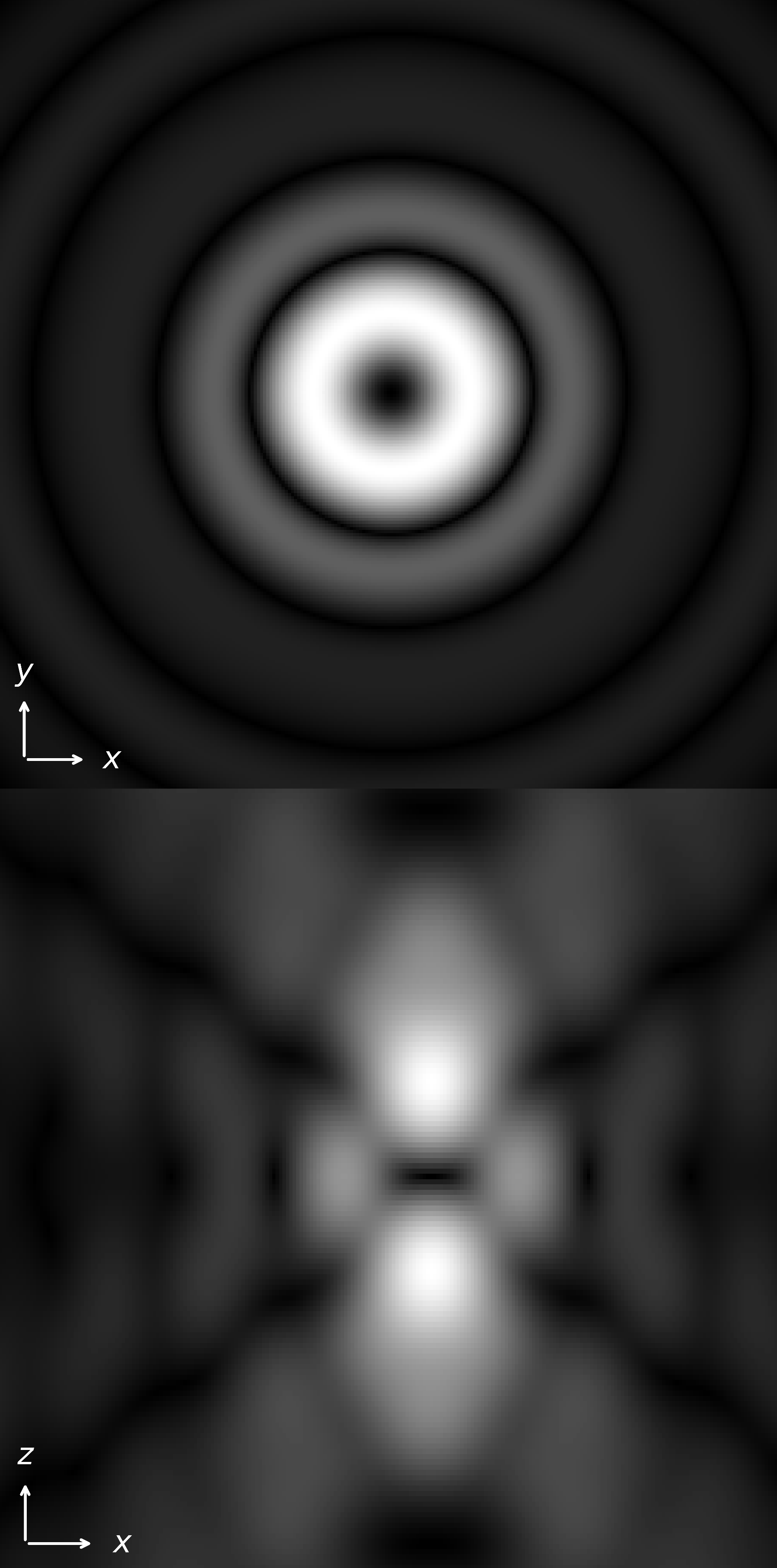
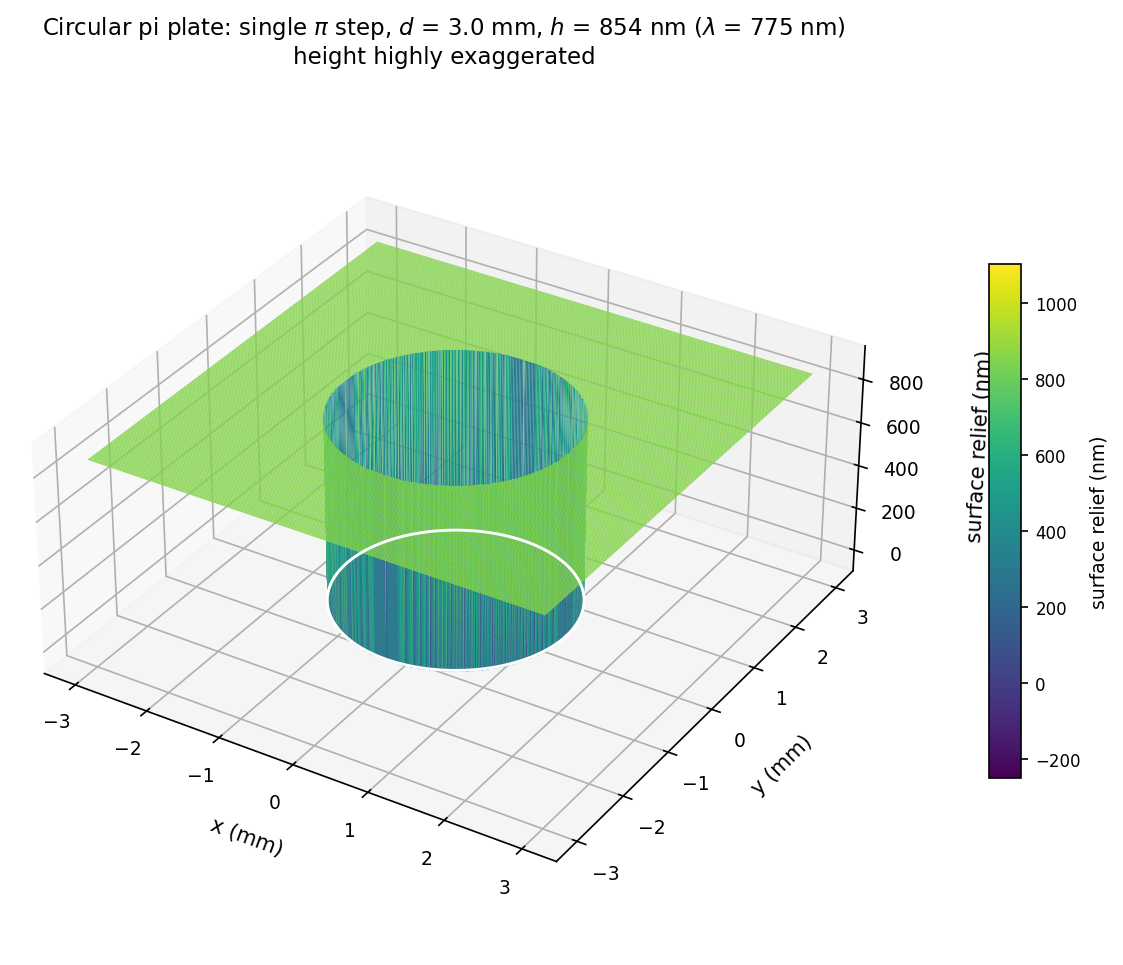
- Circular Pi Plate (Axial Phase Plate): A binary two-level element that shifts the phase of only a central circular zone by π (half a wavelength). It carries no orbital angular momentum and confines light axially, causing destructive interference at the focal point and producing a 3D “bottle beam” (z-doughnut) flanked by two axial intensity lobes.
How do I choose the right zone diameter (d) for a Circular Pi Plate?
To produce a deep on-axis intensity zero, the field integrated over the inner π-shifted disc must equal the field integrated over the outer ring. For an incident Gaussian beam of 1/e2 intensity diameter D, this gives the closed-form matching condition:
d = D · √(ln 2) ≈ 0.83 · D
We offer four standard zone diameters (tolerance ±0.5%, residual on-axis intensity <10−3 of lobe peak) at every design wavelength (405, 488, 532, 592, 640, 660, 775, 780, 800, 1030, and 1064 nm) so you can match your collimated beam directly without adding a beam-expanding telescope:
| Zone Diameter (d) | Matched Beam 1/e2 Diameter (D) | Matched Beam 1/e2 Radius (w) | Part Number Suffix |
|---|---|---|---|
| 0.2 mm | 0.24 mm | 0.12 mm | -200 |
| 1.0 mm | 1.20 mm | 0.60 mm | -1000 |
| 2.0 mm | 2.40 mm | 1.20 mm | -2000 |
| 3.0 mm | 3.60 mm | 1.80 mm | -3000 |
Need a non-standard zone diameter? Request one via our Circular Pi Plates or Custom Products page.
How are Spiral Phase Plates and Circular Pi Plates combined in 3D STED microscopy?
In 3D STED microscopy, a Spiral Phase Plate provides lateral (xy) depletion confinement while a Circular Pi Plate provides axial (z) confinement:
- Split the depletion laser into two arms (one containing the SPP, the other containing the Circular Pi Plate).
- Recombine both arms incoherently (via orthogonal polarizations or an optical path delay longer than the laser coherence length) so the two patterns add in intensity without interfering.
- A half-wave plate before the splitter tunes the power ratio (typically starting around 70:30 in favor of the xy-doughnut for nearly isotropic 3D resolution), followed by circular polarization matched to the vortex handedness.
4. Materials, Substrate Sizes, Coatings & Damage Threshold
What materials and substrate dimensions are used for Vortex Photonics optics?
All standard Vortex Photonics diffractive elements are monolithically structured into pure optical-grade fused silica (and UV-grade fused silica for deep-UV lines such as 193 nm) with no polymers or adhesives in the optical path:
- Standard Apertures & Dimensions: 6 mm clear aperture (6 × 6 × 2.5 mm substrate, available for Spiral Phase Plates), 10 mm clear aperture (11 × 11 × 2.5 mm substrate), and 20 mm clear aperture (22 × 22 × 2.5 mm substrate).
- Optical Quality: 40-20 scratch-dig surface quality, λ/10 transmitted wavefront flatness over the clear aperture, 2.5 mm (±0.1 mm) thickness, ±5 nm step-height accuracy, and <1 µm zone edge width.
What is the transmission, AR coating availability, and laser-induced damage threshold (LIDT)?
- Transmission & AR Coatings: Standard uncoated fused-silica plates deliver ~92.6% to 93.6% transmission (Fresnel-limited over both surfaces). Custom broadband or V-coat antireflection (AR) coatings are available on request to maximize throughput and eliminate back-reflections.
- High Laser Damage Threshold (LIDT): Because the phase profile is etched directly into pure fused silica, our plates withstand high peak and average powers—typically > 10 J/cm2 (1064 nm, 10 ns pulses, uncoated), 2–3 J/cm2 for femtosecond pulsed lasers, and in the high kW region for continuous-wave (CW) lasers—making them ideal for laser micromachining and high-harmonic generation.
5. Alignment, Wavelength Detuning & Optics Toolbox
How should I handle and align a phase plate in my optical setup?
- Remove First Contact Protective Polymer First: Every optic ships coated with a protective optical-grade First Contact polymer to keep the surface spotless during transit. Peel it off cleanly using the supplied removal sticker before inserting the plate into your beam path (see the instructional video below).
- Beam Position & Spatial Filtering: Place the plate in a collimated, spatially filtered Gaussian beam at a plane conjugate to the back pupil of the focusing lens or microscope objective.
- Centering & Tilt: Either side may face the laser (the structured side is marked). Lateral centering is the primary alignment parameter: keep decentring below 1% of the beam radius (e.g., <10 µm for a 2 mm beam). Tip and tilt are uncritical up to a few degrees.

Can I use a phase plate away from its exact design wavelength?
Because the physical step height h = λ / [2 · (n(λ) − 1)] is calibrated for a specific design wavelength λ0, operating at a detuned wavelength introduces a phase-depth error β:
- Spiral Phase Plates: For sectoral (height-reset) SPPs, intended-order conversion efficiency follows sinc2(β − 1) independent of charge ℓ, whereas single-ramp SPPs scale as sinc2(ℓ(β − 1)). For example, a +1% wavelength shift (e.g., 526.68 nm laser on a 532 nm SPP) corresponds to an effective charge of ℓ = 1.01.
- Circular Pi Plates: Residual on-axis intensity scales approximately as sin2(π Δλ / (2 λ0))—a 1% wavelength offset leaves only ~2.5 × 10⁻⁴ of peak intensity on axis. For STED depletion, staying within roughly 1% of the design wavelength is recommended.
For tunable or broadband ultrashort lasers, contact us to select an optimal compromise design wavelength, or test your exact wavelength shift immediately:
Model wavelength detuning in Optics Toolbox →
Are there free calculators to simulate vortex beams, detuning, or mode conversion before ordering?
Yes. Our free, browser-based Optics Toolbox provides five wave-optical engineering calculators using exact scalar diffraction and Malitson fused-silica Sellmeier dispersion:
- Vortex Focal Spot Calculator: Computes focused ring peak diameter, inner/outer 1/e² or FWHM diameters, radial width, and astigmatism via exact order-ℓ Hankel transforms.
- Wavelength Detuning & Conversion Efficiency: Evaluates phase-depth error (β), sectoral vs. single-ramp detuning, and parasitic order power across wavelengths.
- Multilevel SPP (Far Field): Compares continuous vs. N-level staircase elements (2 to 64 levels) with full azimuthal harmonic power budgets.
- Multilevel SPP (Near Field): Models Fresnel diffraction intensity and phase maps at propagation distance z after the plate.
- Angular π-Plate Mode Generator: Computes TEM0ℓ petal mode cross-sections and 2D focal intensity maps.
6. Custom Optics & Ordering
Can Vortex Photonics manufacture custom phase plates, and what specs do you need for a quote?
Yes. Alongside our standard off-the-shelf catalog, we engineer custom optical components tailored to your exact wavelength, topological charge, zone diameter, substrate geometry, or AR coating.
To request a fast quote, you can add standard items or custom configurations directly to your quote cart on the Spiral Phase Plates, Mode Converters, or Circular Pi Plates pages, or send us:
- Design wavelength(s) (in nm)
- Collimated incident beam diameter (1/e2) and laser parameters (CW or pulsed, pulse duration, average power / pulse energy)
- Desired topological charge (ℓ), Hermite-Gaussian mode (TEMpl), or zone diameter (d)
- Outer substrate dimensions, clear aperture, and optional AR coating requirements
How quickly do you respond to quote requests, and how can I contact you?
Our engineering and sales team responds within one business day. Note that online quote requests require an official company, laboratory, or university email address and are subject to our General Terms and Conditions of Sale.
- Email: info@vortex-photonics.de
- Business Hours: Monday – Friday, 8:00 am – 6:00 pm (CET)
- Direct Inquiry: Use the contact form below or visit our Contact page.
7. Key Optical Terms (Quick Glossary)
Short definitions of the core optical physics terms used across our datasheets, product catalogs, and Optics Toolbox.
- Topological Charge (ℓ or m)
- The integer number of full 2π azimuthal phase twists imprinted around the beam axis by a spiral phase plate. Higher |ℓ| increases the doughnut ring diameter and carries ℓħ of orbital angular momentum per photon.
- Optical Vortex (Doughnut Beam)
- A laser beam with a helical wavefront and a central phase singularity where destructive interference forces the intensity to zero, forming a dark core surrounded by a bright ring.
- Orbital Angular Momentum (OAM)
- Angular momentum carried by a light beam’s twisted spatial wavefront (ℓħ per photon), distinct from circular polarization (spin angular momentum). Used to rotate trapped particles and multiplex optical data channels.
- Phase Singularity
- The central point along an optical vortex axis where the optical phase is undefined, resulting in a zero-intensity dark core essential for STED and MINFLUX nanoscopy.
- Phase Quantization (64-Level / Multilevel)
- Approximating a smooth helical phase ramp using discrete etched height steps (e.g., 64 levels per 2π). More steps suppress parasitic diffraction orders and deepen the central intensity zero.
- Bottle Beam (z-Doughnut)
- A 3D focal intensity distribution with a dark zero-intensity center flanked by bright axial lobes above and below the focus, generated by a Circular Pi Plate for 3D STED or dark optical traps.
- Hermite-Gaussian Modes (TEMpl)
- Higher-order transverse laser beam profiles with rectilinear zero-intensity nodal lines (such as TEM01 or TEM02), generated from a fundamental TEM00 Gaussian beam using linear π phase steps.
- 1/e² Beam Diameter (D) & Clear Aperture
- The 1/e² diameter (D = 2w) is the beam width where intensity drops to 13.5% of its peak, used to size Circular Pi Plates (d ≈ 0.83 D) and focal rings. Clear aperture is the usable structured area of the plate (6, 10, or 20 mm).
- LIDT (Laser-Induced Damage Threshold)
- The maximum laser fluence (J/cm²) or power density an optical surface can withstand before permanent damage occurs. Monolithic fused silica provides high LIDT for both pulsed and CW lasers.
- Wavelength Detuning (β)
- Operating a phase plate away from its design wavelength λ0, which scales the effective phase step height and shifts a small fraction of power into parasitic orders (estimable in our Optics Toolbox).
- Diffractive Optical Element (DOE)
- An optical component with a micro-structured surface relief that shapes light via phase modulation and diffraction rather than bulk curvature, enabling custom profiles such as optical vortices, bottle beams, and higher-order modes.
- Laguerre-Gaussian Modes (LGpℓ)
- Cylindrically symmetric laser beam modes defined by azimuthal index ℓ (topological charge) and radial index p. A Spiral Phase Plate converts a Gaussian beam into an optical vortex closely approximating an LG0ℓ doughnut mode at focus.
- STED & MINFLUX Microscopy
- Super-resolution fluorescence nanoscopy methods that use a zero-intensity doughnut beam (from an SPP) or axial bottle beam (from a Circular Pi Plate) to confine or localize emitters well below the Abbe diffraction limit.
- Anti-Reflection (AR) Coating (V-Coat vs. Broadband)
- Thin-film dielectric layers applied to fused silica to suppress Fresnel reflections and raise transmission above the ~93% uncoated baseline. V-coats optimize a single laser line; broadband AR coatings span a wider spectral range.
- Spatial Filtering
- Focusing a laser beam through a pinhole and recollimating it to strip away spatial distortions and noise, producing a clean Gaussian wavefront essential for achieving a deep central intensity zero after a phase plate.
- Sectoral (Height-Reset) vs. Single-Ramp Relief
- Two surface geometries for higher-charge (ℓ > 1) SPPs: sectoral plates reset physical height every 2π across ℓ segments for broader wavelength tolerance, while single-ramp plates accumulate the full ℓ×2π height (comparable in our Optics Toolbox).